

Choosing a base of operations used to be straightforward: you found an empty commercial lot, signed a multi-year lease, renovated the interiors, and put your company name on the glass door.
But as we navigate the modern business landscape, that dynamic has fundamentally shifted. With commercial real estate in Greater Kuala Lumpur undergoing major transitions—marked by a widening gap between older corporate towers and premium, highly accessible flexible spaces—decision-makers are facing a critical crossroads (EdgeProp).
Should your business opt for the agility of a co-working space, or does the complete control of a traditional office still hold the crown?
To help you decide, let’s look at how both stacks up against the operational realities of running a business today.
The Head-to-Head Comparison
| Feature | Co-Working Space | Traditional Office |
| Upfront Capital (CAPEX) | Zero. Fully furnished and move-in ready. | High. Requires renovation, ID, IT setup, and furniture. |
| Lease Flexibility | Month-to-month or 1-year terms. Easy to scale up/down. | Rigid 2-to-3-year commitments with steep exit penalties. |
| Hidden Overhead Costs | None. Utilities, WiFi, printing, and cleaning are bundled. | Variable. You pay for electricity, maintenance, and facility management. |
| Brand Autonomy | Shared common areas with private office customization options. | Complete control over corporate layout, culture, and branding. |
| Talent Well-being | Built-in lifestyle perks, community managers, and break zones. | Dependent entirely on your internal budget and design choices. |
When Co-Working Wins: The Case for Absolute Agility
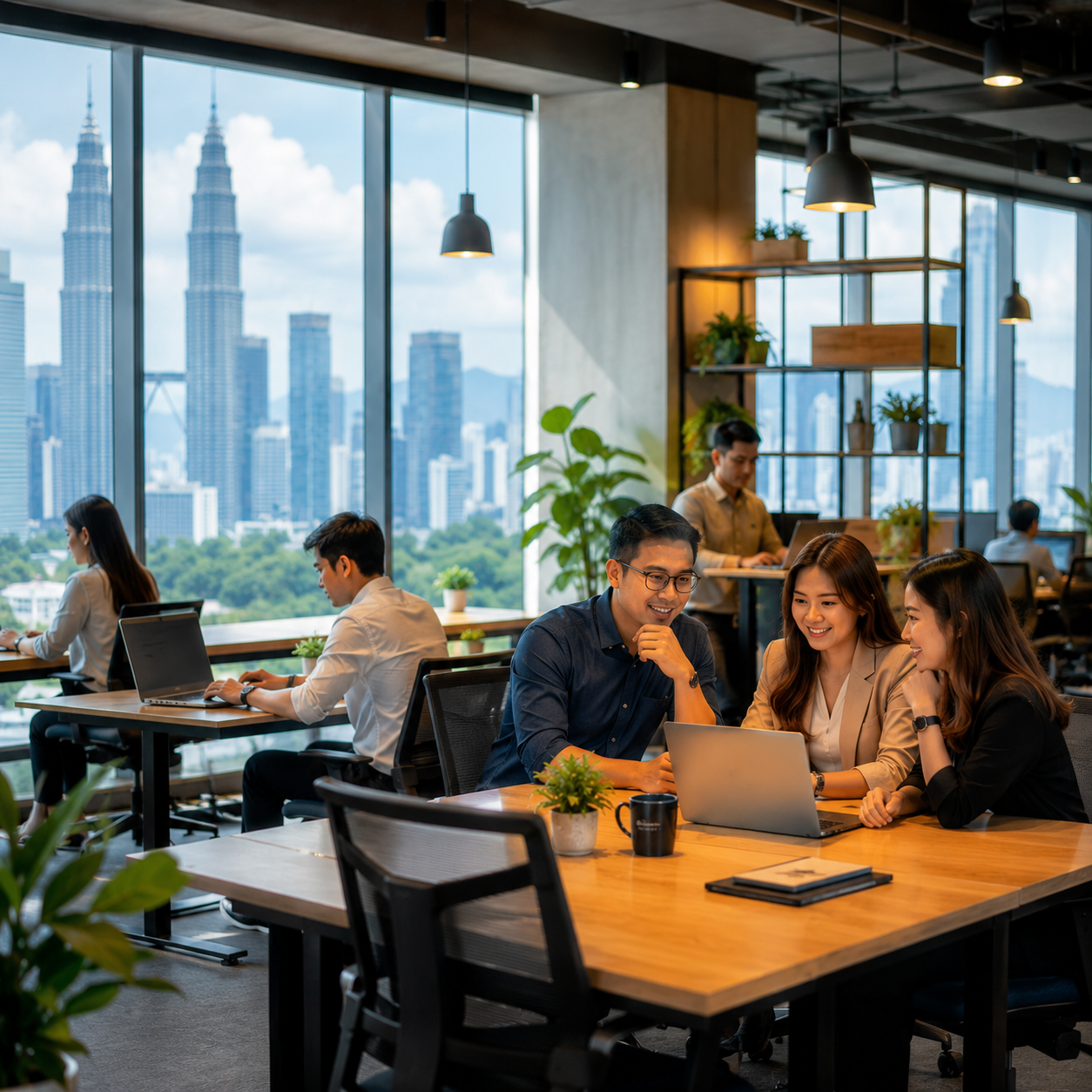
Co-working spaces have evolved far beyond hot desks for freelancers. Today, they are highly sophisticated enterprise solutions tailored for fast-moving small-and-medium enterprises (SMEs), regional teams, and scaling startups.
1. Mitigating Massive Cash Flow Risks
Setting up a traditional brick-and-mortar office in hot economic zones like KL Fringe or Petaling Jaya requires massive capital sinkage before you even generate a single Ringgit from the space. Co-working removes this hurdle entirely. By turning capital expenses (CAPEX) into predictable operational expenses (OPEX), companies can channel saved funds directly into product development, marketing, or hiring top talent.
2. High-Yield Efficiency
In a traditional office, you pay rent for the entire floor plan—including meeting rooms that sit empty 70% of the day, corridors, and server closets (AM Office). Co-working optimizes space efficiency. You only pay for the private office desks your team uses daily, while enjoying free, on-demand access to premium shared amenities like soundproof call booths, massive boardrooms, and fully stocked pantries.
3. The Wellness and Retention Magnet
Modern teams heavily prioritize workplace wellness and location convenience over empty corporate prestige (Savills/StarProperty). Premium flexible workspaces are intentionally built near major transit links (LRT/MRT) and feature vibrant, hospitality-driven environments that make employees want to show up, fostering an effortless balance between work and lifestyle.
When a Traditional Office Wins: The Case for Total Control
Despite the flexible workspace boom, the traditional office model isn’t dead—it has simply become highly specialized for specific corporate profiles.
1. Tailored Security and Data Compliance
For highly regulated industries—such as legal firms, financial institutions handling sensitive data, or cyber security providers—data integrity is paramount. While premium co-working spaces offer private VLANs and secure server racks, certain corporations require complete ownership over their physical infrastructure, hardware, and access control systems to meet rigid global compliance standards.
2. Deep-Rooted Corporate Branding & Culture
If your business depends heavily on shaping a highly specific, immersive client journey or maintaining a rigid, private internal culture, a traditional office gives you a blank canvas. From the moment a stakeholder steps out of the elevator, every wall texture, lighting fixture, and floor plan layout can be customized to reflect your corporate identity and legacy.
The Ultimate Decision Framework: Which Fits Your Business?
To choose the right path, skip looking purely at price per square foot and look instead at your business intent over the next 12 to 24 months.
Choose a Co-Working Space if:
- You are an SME or scaling tech team whose headcount could wildly fluctuate over the next year.
- You want to eliminate administrative headaches (handling internet downtime, managing office cleaners, ordering pantry supplies) so you can focus 100% on core business operations.
- You want to leverage decentralized or suburban hubs to save your team from long commutes.
Choose a Traditional Office if:
- You have a massive, highly stable workforce (typically 80+ employees) with zero plans for headcount fluctuations.
- Your operations require specialized physical infrastructure, heavy secure storage, or custom laboratory setups.
- Your business model heavily relies on standalone, high-security corporate prestige and total environment control.
The Bottom Line
The line between the two models is blurring, with many enterprises now adopting a hybrid approach—retaining a smaller core traditional headquarters while empowering regional departments with agile, localized co-working private offices. Ultimately, the best workspace isn’t the one with the longest lease; it’s the one that gives your business the agility to adapt, scale, and thrive.
Sources & Reference Insights
- Macro Property and Rental Recalibration Trends: EdgeProp Malaysia (May 2026) – Commercial real estate analysis from BNM and Knight Frank on prime office rental trends, shifting occupier demands, and space utilization.
- Workplace Wellness & Hybrid Shifting Forces: Savills Malaysia Real Estate Outlook via StarProperty (January 2026) – Expert insights detailing why modern occupiers focus heavily on flexibility, wellness features, and accessibility when selecting work environments.
- Office Space Yields and Dynamic Layouts: AM Office Malaysia Trends (January 2026) – Data exploring the inefficiencies of single-use spaces in traditional corporate offices and the shift toward fluid, high-yield zones.